
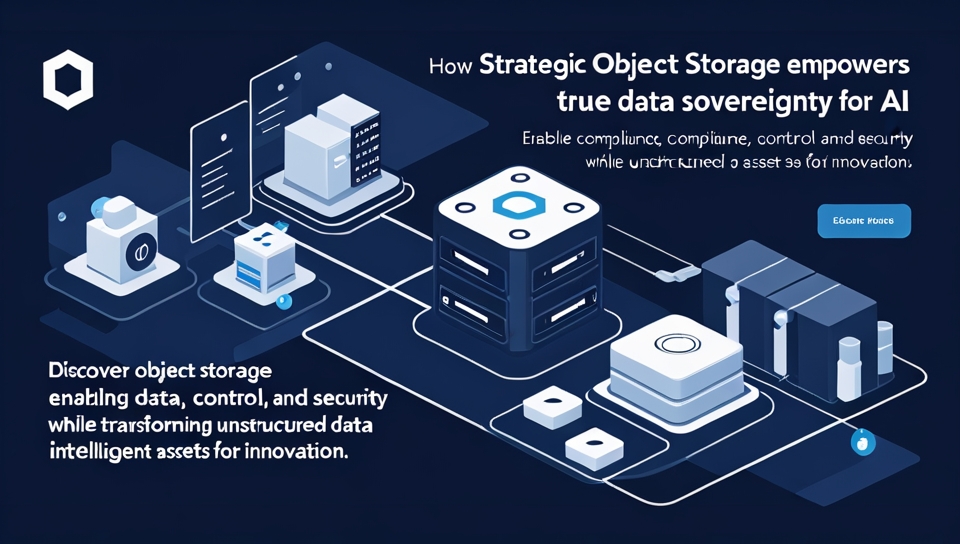
Data Sovereignty and Object Storage: Building Trustworthy, Compliant AI
Data Sovereignty in AI: Strategic Object Storage’s Essential Role
In today’s AI-driven world, the buzz around data sovereignty is getting louder. It’s all about businesses taking full control of their data and ensuring it’s not lost in the shuffle of third-party clouds or systems. This level of control is crucial for building trust, staying compliant, and maintaining autonomy in the entire AI journey.
Data sovereignty is more than just keeping data local. It demands complete governance over every data-related process—from how data is brought in and stored, to the insights derived from it. According to Gartner, by 2027, 70% of organizations venturing into generative AI will focus heavily on digital sovereignty and sustainability when choosing public cloud services.
Rethinking Data Control
Imagine an automotive company launching an innovative electric vehicle. On the surface, it seems they control the design and branding, but if assembly, parts procurement, or even software management falls to overseas vendors, their grip might not be as firm. And if vehicle data is pulled from mixed storage solutions, governance gets tricky. Hence, the question is: Does the company truly own its product?
The same goes for AI—businesses may train AI models in line with local rules, yet unknowingly let go of data control to others. This loss undermines their command over digital assets and questions their sovereignty.
Transforming Object Storage into Intelligent Memory
For genuine data sovereignty, systems to track data origins, access, and usage are mandatory throughout the AI lifecycle. Without these, companies risk establishing overseen, unreliable AI systems that can’t meet regulatory demands.
Innovations like Retrieval-Augmented Generation (RAG) highlight the vital role of object storage. It must evolve from mere data storage to an active part of AI processes, enabling models to fetch and process unique data contexts efficiently.
Strategic Infrastructure for AI
Object storage should become a key asset in an enterprise’s AI setup—not just storing data, but also indexing, enriching it with metadata, and supporting strong governance for accountable AI outcomes.
For modern AI needs like RAG, reassessing object storage for security, transparency, and governance, alongside scalability and cost, is paramount.
Governance and Security as Imperatives
New governance standards involve detailed access control with role-based permissions, ensuring sensitive data stays safe while consistent privacy policies are maintained. Keeping audit trails for data interactions is crucial for compliance and analysis.
Additionally, aligning data residency with local legal requirements is vital for enterprises in heavily regulated sectors.
Adapting to New Technical Realities
Current object storage solutions are adopting API-first designs, allowing them to connect with modern AI systems and leverage semantic search with vector databases, making relevant data available for AI decision-making.
Ultimately, aspiring for data sovereignty in AI requires more than robust infrastructure. It calls for an environment where data stays visible and manageable, fostering responsible AI systems and positioning object storage as critical for achieving digital sovereignty.
—
For more insights and updates on AI, data sovereignty, and strategic storage solutions, stay tuned with Qsentinel.
Ready to take data security seriously?
Discover how Qsentinel can protect your organization against ransomware, enforce true data sovereignty, and stay ahead of the quantum threat. Their purpose-built workspace is designed for exactly that.

Get daily news in your inbox
The lastest on Hacks, ransomware attacks, post quantum security and more


