
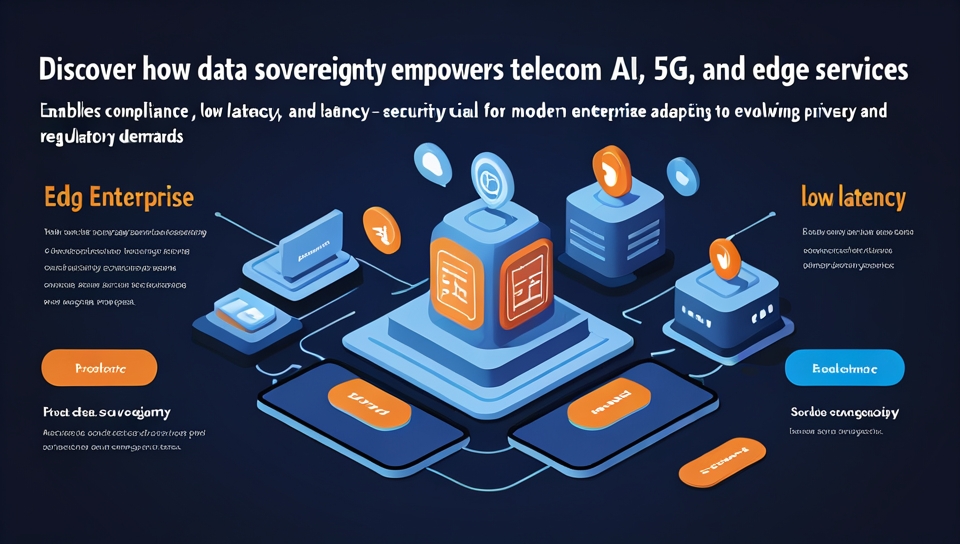
How Data Sovereignty Drives AI, 5G, and Edge Innovation in Telecom
Facilitating AI Growth Through Data Sovereignty and 5G
Artificial intelligence (AI) is no longer just a topic for tech enthusiasts; it’s transforming telecommunications right now. With the rise of 5G and the strategic use of edge computing, AI is set to revolutionize how we connect and interact. Maintaining control over data—especially in how it’s managed and protected—becomes increasingly crucial. That’s where data sovereignty comes in, ensuring data is controlled within specific jurisdictions.
As 5G networks become the global norm, the telecom industry must rapidly adapt. Edge computing helps bring AI closer to users, delivering faster and more reliable services. Managed Service Providers (MSPs) are stepping in to build AI cloud infrastructures that respect geographical data rules. This allows telecom operators to refine and expand AI-driven services at incredible speeds.
Take sectors like healthcare or finance—they can benefit massively from AI, but local laws demand strict data governance. Here, MSPs have the opportunity to provide tailor-made solutions, ensuring every byte of data meets local regulations while unlocking the full power of AI.
Sovereign AI Clouds: The New Frontier
The integration of sovereign AI clouds combined with edge technology isn’t just a trend—it’s becoming a necessity. Adapting digital sovereignty means letting telecoms offer innovative, high-performance AI services without skirting privacy laws. This strategic move will see sovereign AI solutions capturing a significant slice of the global AI infrastructure winnings.
Traditional models are shifting. Instead of hierarchical systems, we’re seeing more horizontal, efficient frameworks that prioritize real-time processing while safeguarding user data. Analytics, often synonymous with latency, can now be immediate thanks to 5G and edge capabilities, a boon for emerging technologies like autonomous systems and immersive experiences.
Managed Service Providers are crucial partners in realizing these advancements. By developing bespoke infrastructures, MSPs enable telecoms to tap into localized AI networks, leveraging powerful new services tailored to specific geographical and regulatory landscapes.
Navigating the Regulatory Labyrinth
Today’s regulatory landscape is complex, with directives like GDPR setting a high bar for data protection and AI risk management. Sovereign AI solutions hinge on automating such compliance, integrating real-time monitoring to adapt rapidly to regulatory changes. This is where advanced tools for managing compliance and ensuring robust network resilience come into play.
Through initiatives like zero-trust architecture and continuous security oversight, MSPs are providing robust frameworks for telecom operators. This allows a seamless integration of sovereign AI platforms ensuring both unrivaled security and dynamic service adaptability.
The benefits of sovereign AI cloud systems are immediately noticeable—not only in terms of compliance but also in operational resilience and cost efficiency. These platforms offer telecom providers a chance to evolve continuously, promising future-ready solutions that meet—and exceed—current expectations.
Ready to take data security seriously?
Discover how Qsentinel can protect your organization against ransomware, enforce true data sovereignty, and stay ahead of the quantum threat. Their purpose-built workspace is designed for exactly that.

Get daily news in your inbox
The lastest on Hacks, ransomware attacks, post quantum security and more


